Animals, Interactive notebook, notebooking

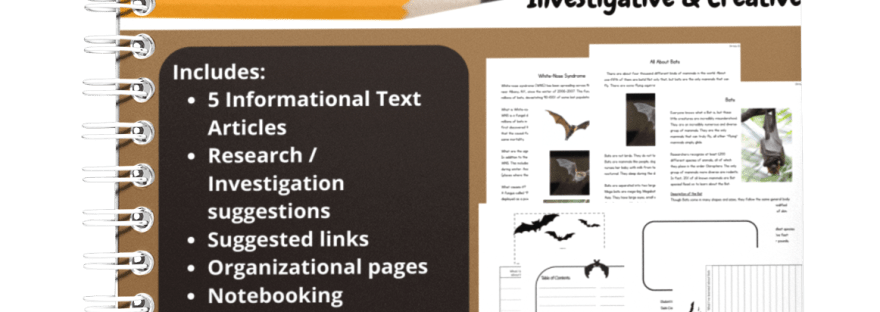
Bats – Notebooking Unit!

These cool critters have something of a sinister and spooky reputation – but they don’t deserve it! Come on gang, let’s check out some brain-boggling bat facts…

Bat facts!

1. There are more than 1,300 bat species!

That makes them the second most common group of mammals, after rodents. In fact, around a fifth of all mammals on Earth are bats!

2. Bats are found almost everywhere on Earth!

bat facts | a bat with long ears is perched on some wood

Other than the polar regions, extreme deserts, and a few isolated islands, bats live in every habitat on Earth. Many species spend their time in huge tropical rainforests, while others inhabit grasslands, woodlands, and wetlands.

3. Some species weigh less than a penny, while others have a whopping 1.8m wingspan!

Some of the biggest bat species are part of a group known as megabats! These whopping bats live in the tropics, where they hang out in trees, snacking on fruit, nectar, and pollen.

DID YOU KNOW?

The majority of bats are known as ‘microbats‘. Unlike their megabat cousins, these species come out at night to munch on insects.

4. Bats sleep upside-down

bat facts | a bat roosting upside down on a cave roof

Whether hiding in dark caves, sneaking into old tree hollows, or even living in the roofs of old buildings, all bats need a safe place to snooze – where they hang suspended from their feet! Scientists think this sleeping strategy allows bats to easily escape from predators, as they can drop straight into flight.

5. Most bats use sound to ‘see’ the world around them

This nifty navigation system is called echolocation! Bats send out waves of sound from their mouths or noses, which bounce off their surroundings right back to their ears. By listening to the echoes, bats can build up a picture of exactly what’s around them – including juicy insects!

WEIRD BUT TRUE!

Have you ever heard the phrase ‘blind as a bat’, to describe someone who can’t see very well? Well, this old saying is totally inaccurate, as bats have good eyesight as well as awesome hearing!

6. Ancient civilisations worshipped bat-like gods

bat facts | a flying fox swoops in front of a tree where others are roosting

The Aztecs celebrated many Gods including Mictlāntēcuhtli, the principle God of the Dead. This ancient deity had a scrunched, bat-like face and clawed hands and feet!

7. The scientific name for bats is Chiroptera, which means ‘hand wing’

Look closely and you’ll see why… Each bat wing is actually a thin layer of skin stretched between four long fingers and a thumb! In fact, the structure isn’t all that different to a human hand, or a crocodile’s footWow!

8. Blood-sucking ‘Vampire bats’ are real… Eek!

There are three species of blood-drinking bats, but don’t worry – they tend to prey on livestock like cattle and horses, attacks on humans are very rare! Vampire bats can be found hunting at night in Mexico and other Central and South American countries.

9. When in flight, bats hearts beat 1,000 times a minute!

Some bat species can eat up to 1,200 mosquitoes an hour during their nightly hunts. With such busy feeding frenzies, their bodies are working overtime!

10. Bats are hugely important for people and the planet

Did you know, bats are pollinators, just like bees and butterflies? In fact, hundreds of plant species rely on bats to pollinate them, including fruits like bananas, avocados, and mangos! The bats then poop out the seeds, helping to disperse new trees.

Plus, bats all over the world eat millions of insects every night, protecting people from diseases spread by insects and reducing the amount of pesticide that farmers need to use to keep their crops bug-free. Cool!

All-Access members do not pay for this or any resource. Become an All-Access member today!

interactive learning, Spring

Creative Spring Activities for Homeschoolers

Spring is such a wonderful time to embrace homeschooling! It’s a season of renewal. A season offering times of exploration. A time to incorporate hands-on, creative learning experiences! In this post, I hope to awaken some ideas for you. I also want to suggest some ready-to-use resources that you can easily incorporate into fun, creative Spring learning!

Nature studies are a wonderful addition to any homeschool curriculum! They help foster curiosity, environmental awareness, and a love for the natural world. Here are some ideas and resources to incorporate. These resources will encourage your kids to document their surroundings—sketching plants, animals, or landscapes they see….and much, much more! There is something for ALL-AGES!!

ABC Nature Hunt

A FUN nature hunt that can be used by an individual student, a group of students or an entire family!

Life Cycle of a Frog | Differentiated

This 1st / 2nd Grade Science resource provides postershandouts and center activities to help students learn about the life cycle of a frog! Seven stages are shown and pages come in color and b/w. Easy to use and differentiated (Based on student ability – Easiest: Color the life cycle / Medium: Color, cut and paste the life cycle / Hardest: Draw the life cycle)

Life Cycle of a Flower| Science Student Created Book

This cross-curricular (Science Literacy – Writing ) product will have students creating their very own mini-books detailing the life cycle of a flower! Knowledge students will learn: Students will learn what flowers (plants) need to live and grow (soil, water, sun, air) and how a planted seed becomes a sprout, then a seedling and then a beautiful flower. Students will:— read the text — draw a picture — write (copy) the written text— write (copy) the written text

Life Cycle of a Butterfly | Science Student Created Book

This Science – Language Arts resource with have students creating their very own mini-book of the life cycle of a butterfly! Knowledge students will learn: The book will begin with the butterfly laying an egg on a leaf and continue as a caterpillar begins to grow in the egg, hatches and begins to eat. Students will learn what the caterpillar eats and that it is a type of larva. As the book progresses, students will write about the caterpillar building a cocoon and it’s life as a pupa (and a chrysalis) before emerging as a beautiful butterfly! On each page, students will … read the text, draw a picture and then write (copy) the written text.

Mushroom Bundle | Studying Fungi

My Teaching Library has bundled 5 MUSHROOM products to help you SAVE and have a variety of fantastic classroom resources to help you teach.
– If you want to give your student(s) a fun, research-based unit study, this bundle is for you!
– If you teach Science for 6th-12th grades, this bundle is for you!
– If you teach an outdoor nature-based class, this bundle is for you!

North American Birds of Prey Research / Report Pages

Birds of Prey’ is a 41 page download and offers pages specifically designed to help students organize and present research reports for each bird. Also included are several ‘blank’ pages for students to use when researching other birds as well as pages to add additional information to any report.

    5 Paragraph Writing Guide | Nature-Themed Local Birds

    Easy-to-use, step-by-step, print-and-go guide for students to use as they learn to write a 5-paragraph essay! This nature-themed resource has a local bird focus and guides students as they research, observe and write about one bird species that lives in their local area.

    This 3-page resource outlines paragraph by paragraph what to include and gives space for students to write detailed notes.

    What will students learn and observe about a bird species before they begin writing?
    – where the bird geographically lives
    – habitat(s) where they are most likely found
    – physical characteristics (coloring, markings, size, bill, feet)
    – diet (herbivore, carnivore, omnivore) and where/how they find/gather their food
    – predators and self-protection
    – interesting facts

    Plus, this guide will encourage students to reflect on what they have learned.

    Once completed, students will be able to take the guide and their notes and write amazing 5-paragraph essays!

    Use once as one assignment for one bird of their choice or use again and again to create an entire collection of essays on local birds. Regardless of where you live, these pages will have students observing and learning about local birds.

    Let’s Learn about Plants | Science for 1st and 2nd Grades

    Let’s Learn about Plants is a Science resource that can be used in conjunction with your own curriculum or as a separate – individual unit! Students will be actively learning as the cut, color, paste, write and learn! They will learn about the parts of a plant and the life cycle!

    Botany – Plants | Interactive Learning

    Give students an engaging way to learn about plants with this interactive, project based resource. Designed to be used for multiple ages and grades, 2nd-6th grades, students will learn about plants:
    – classification
    – photosynthesis
    – the plant cell
    – parts of the plant
    – things plants need to grow
    – the life cycle of a plant
     – plant leaves
     – different types of plants (non-flowering, carnivorous, poisonous)

    These are just a few ideas to get you started! My Teaching Library has many other NATURE-THEMED resources that you’ll find on MyTeachingLibrary.com!


    All-Access members do NOT pay for ANY OF THE ABOVE RESORUCES or ANY resource on My Teaching Library!
    Become an All-Access member today!

    ________________________

    Get the MOST from My Teaching Library by connecting with us here:
    FB Group (PRIVATE GROUP)
    FB Page
    Instagram
    Pinterest
    X (formally twitter)
    YouTube
    Birds, Interactive notebook, notebooking

    Let’s Study the Great Gray Owl!

    Photo by Lynda Ackert (All Rights Reserved)

    This tall gray owl, patterned with brown and white mottling, streaks, and barring, sports a large facial disk and yellow eyes. As with all owls, its eyes are immobile, aimed instead by extremely flexible head movements. It lacks ear tufts, and its chin and the space between its eyes (lores) bear prominent white patches. Though taller and appearing larger than the great horned owl (Bubo virginianus) due to its fluffy plumage, it actually weighs less. Its slow, easy flight is described as heron-like.

    Photo by Lynda Ackert (All Rights Reserved)
    Kingdom:Animalia
    Phylum:Chordata
    Class:Aves
    Order:Strigiformes
    Family:Strigidae
    Genus:Strix
    Species:S. nebulosa

    Habitat and Distribution

    Most great gray owls nest in the dense northern boreal forests across North America and Eurasia. The southernmost edge of their range, however, dips down through the Cascades and Klamath Mountains of the Pacific Northwest, into the Sierra Nevada of California and includes the northern Rocky Mountains. Scarce winter food sometimes drives them even further south. They need mature forest habitat with openings that sustain their primary prey: small rodents. In the Pacific Northwest, pine, oak/madrone, Douglas-fir and other forest types bordering bogs, fields, or meadows are suitable.

    Diet and Foraging

    Great gray owls primarily hunt at night or at dawn and dusk, though they are capable daytime foragers. Voles (Microtus spp.) comprise almost 90% of their diet. Low vole populations, in fact, can significantly lower owl reproduction and trigger mass owl movements south (irruptions) in search of food for the winter. Equipped with powerful hearing, thanks to offset ear openings and a large facial disk, the owls hunt from low perches on the edge of openings. Like most owls, special structures on their feathers—a comb-like filter on the front of flight feathers and a velvety layer across the surface—make their flight almost soundless. They can hear small rodents deep under the snow. (Continue reading)

    For Students: Great Gray Owl | Notebooking Report Pages

    This Great Gray Owl resource includes ten pages perfect for any student creating a report or project on this bird! There are nine pages that can be used to record findings such as its scientific classification, range, habitat, diet and much more. The last page includes a full black and white illustration so that students can create a colorful picture of this magnificent owl.


    Related resources you might like…

    Learn about All-Access! 

    ________________________

    BE the FIRST to know about NEW Products by joining the…

    My Teaching Library FB group
    Posts are made in this group first!!

    Subscribe to My Teaching Library newsletters!

    Spring

    Spring Themed Writing Paper


    Spring Writing Paper

    Need something to easily inspire student creativity? Give them paper that they will want to use to publish their work! It can be that easy!!

    My Teaching Library offers a Spring Writing Paper resource with 101 different designs.

    These colorful 101 pages are perfect for all types of writing assignments, fun stories and creative poems. Use the around holidays like Easter and Mother’s day, or to assigne reports on Spring weather, nature and much, much more.


    Here are additional Spring related suggested resources…

    BECOME A LIFETIME SUBSCRIBER AND NEVER PAY FOR ANY PRODUCT ON MY TEACHING LIBRARY!

    ________________________

     Learn more about My Teaching Library!

    BE the FIRST to know about NEW Products by joining the…

    My Teaching Library FB group
    Posts are made in this group first!!

    Subscribe to My Teaching Library newsletters!

    10th Grade, 11th Grade, 12th Grade, 5th Grade, 6th Grade, 7th Grade, 8th Grade, 9th Grade, Geography

    Project-Based 5 Themes of Geography Country Study – Paraguay

    Looking for a project for students to demonstrate their knowledge of and ability to synthesize information surrounding the 5 themes of Geography? Here it is!

    This is a project-based country study on the South American country of Paraguay focusing on the 5 Themes of Geography: location, place, regions, movement and human/environment integration! There are a lot of country studies but this one is different.

    This study will ask students to ‘think like a geographer‘ in their research and recording. Using this resource, students will…

    • – Learn about the country of Paraguay
    • – Demonstrate knowledge of and ability to synthesize information and write about Paraguay through a 5 themes of geography lens.
    • – Create a wonderful project displaying their learning.

    This resource 18 page resource is perfect for any geography classroom and can be used for 5th – 12th grades!

    Sample questions include:

    • – (Location) Describe the relative location of the country.
    • – (Location) What is the latitude and longitude of the capital city?
    • – (Place) What major landforms are found in the country?
    • – (Place) What is/are the climate type(s) of the country?
    • – (Regions) When considering this country, describe and give examples of at least one type of functional region within it.
    • – (Movement) Describe any historically important migration patterns of information you have found about past or current migration for this country. You may include internal, external migration, emigration, immigration, return and/or seasonal migration.
    • – (Human/Environmental Integration) Give examples of how people who have lived in this country changed or modified the environment.

    Please note: Students will need to understand the 5 Themes of Geography  to complete this project.

    My Teaching Library has many additional country studies just like this one!! Here are just a few:

    See all available country studies with this same format here!

    BECOME A LIFETIME SUBSCRIBER AND NEVER PAY FOR ANY PRODUCT ON MY TEACHING LIBRARY!

    ________________________

     Learn more about My Teaching Library!

    BE the FIRST to know about NEW Products by joining the…

    My Teaching Library FB group
    Posts are made in this group first!!

    Subscribe to My Teaching Library newsletters!

    American History, notebooking, Presidents

    Abraham Lincoln | History Project

    Studying the 16th President of the United States, Abraham Lincoln? Wanting your students to develop their ability to research, organize, write and create a complete project? This interactive, hands on, resource is one that can be used in Social Studies, History and Language Arts classes and is designed to be either teacher led or student centered – whichever you prefer!

    This project resource can be assigned individually or to cooperative groups. You can give students as much latitude as you want – or – you can be very deliberate in what and how you assign students to use the pages.

    Includes:

    • “Creating a Notebooking Project – What is Notebooking?” instructional page
    • List of suggested supplies
    • Evaluation rubric (can be used by both teacher and student peer groups!)
    • Teacher directed assignment page (This is designed to be used if you need to ‘guide’ the students on the journey of creating the project – includes due date section)
    • Cover page for student use
    • Table of contents pages for project
    • Project KWL
    • Vocabulary terms page (So students can record and define unfamiliar terms along their study – or – You can assign certain terms to be completed throughout the project)
    • Reference page (For students to record the references they used to complete the project – Includes a # blank so students can place numbers (#’s) throughout their project.)
    • “Using Biographical Notebooking Pages” instructional page for student reference
    • “Guiding Research Questions” page to instruct students on how they can and should create their own research questions along the way.
    • 18 student publishing pages

    Need students to draw from primary and secondary sources? Need students to develop research questions? Need students to analyze statements or events? Make these part of the requirements. This resource is extremely flexible and allows you to make the assignment exactly what you need!

    Other U.S. History resources you’ll love…

    ________________________

    >> Learn more about My Teaching Library! <<

    BE the FIRST to know about NEW Products by joining the
    My Teaching Library FB group
    Posts are made in this group first!!

    Subscribe to My Teaching Library newsletters!

    Lapbooking, notebooking, Uncategorized

    The Process of Electing our Leaders | U.S. Elections

    It’s important that students learn about every aspect of the election process.

    Your students want to learn and they love when given a chance to take charge of their learning! That is why My Teaching Library offers this U.S. Elections themed resource that will give them the opportunities they need to take charge, make decisions, collaborate and learn…all while creating a wonderful project!

    This resource will give the students the opportunity to learn about different aspects of U.S. elections (both local and national elections) and at the same time give them choices as to what they want (or need) to focus on.

    It will also give them the opportunity to choose how they want to work (alone or in a group) and how they present their findingsm using either a notebooking method or creating a lapbook. Of course, if you as the teacher, want (or need) to assign specifics and give them less control, you can do that as well. This resource is flexible!

    Several informational text pages have been provided but students should be encouraged to read books and find other resources to gather information. Perhaps they can watch an upcoming televised debate. Perhaps they can attend a townhall meeting or interview someone.

    Included:

    • Teacher pages for instructions, explanations and evaluations and more
    • Sample questions to get students ‘thinking’
    • Over 100 pages for students to select from when designing their projects! (These student pages have been created ‘in color’ but can easily be printed in b/w or grayscale to save $$$).

    (Please note: If you are a MTL Download Club subscribing member, this resource is FREE!)