Book Units, BUNDLES

Why and How to Add “Little House on the Prairie” Books to your Homeschool lesson plans

If you are teaching 3rd-6th grades, want to teach good chapter books with wholesome messages, these literature units are for YOU! With over 400+ pages in the BUNDLE, you can easily plan to cover an entire year. 

Why read “Little House” books? 

  • Educational Value: The series covers a wide range of topics, including history, science, home economics, and the importance of hard work and perseverance. It can be used to teach children about the challenges and triumphs of life in the past. 
  • Wholesome Values: The books instill positive values such as cooperation, responsibility, and the importance of family. They also highlight the sacrifices made by families to build a better life. 
  • Historical Context: The series provides a window into the lives of early American settlers, offering insights into the culture, traditions, and daily life of the time. 
  • Personal Connection: Many readers find a personal connection to the stories, as they relate to their own experiences or the experiences of their families. The series can evoke memories and emotions that resonate with readers of all ages. 
  • Timeless Appeal: The “Little House” books have stood the test of time, remaining relevant and enjoyable for new generations of readers. They continue to inspire and entertain, making them a must-read for anyone interested in American history and literature. 

In summary, the “Little House” series is not just a collection of stories about a family’s journey westward; it is a rich tapestry of life lessons, historical context, and personal connection that continues to captivate readers of all ages. 

How to add these wonderful books to your lessons
My Teaching Library has created a BUNDLE of units to give you what you need…Easy to use, just print and go!

About the Bundle:

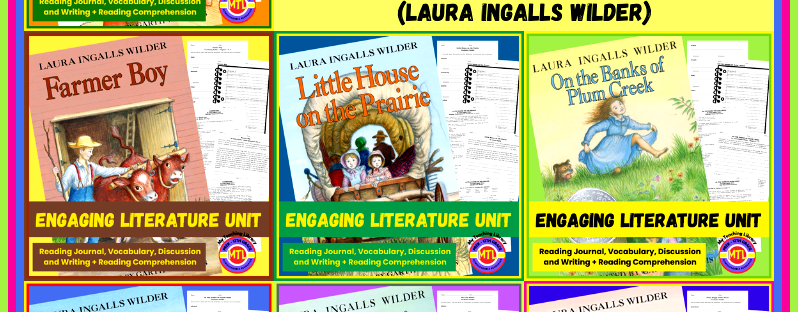
Included in this BUNDLE are full literature units for…

  1. Little House on the Prairie
  2. The Long Winter
  3. Farmer Boy
  4. These Happy Golden Years
  5. Little House in the Big Woods
  6. By the Shores of Silver Lake
  7. On the Banks of Plum Creek

400+ pages in total

Each unit includes:

  • Vocabulary work – Students are asked to find and write a definition, an antonym and a synonym for each word given.
  • Reading journal for every chapter in every book
  • Reading comprehension quizzes (including keys)
  • Essay questions – Many will ask students not only about events in each book but also ask students to relate events to their own lives in some way.
  • Oral discussion questions – Perfect for large or small groups (literature circle) discussions – Great for both Co-ops and one on one parent interaction.

Not sure if you want the entire bundle? Each unit is available for individually purchase, however you’ll save $7.50 when you purchase the bundle! (Unless, of course, you are an All-Access members. Everything is FREE with All-Access!)

Here are the individual units:

  1. Little House on the Prairie Literature Unit | Laura Ingalls Wilder
  2. The Long Winter Literature Unit | Laura Ingalls Wilder
  3. Farmer Boy Literature Unit | Laura Ingalls Wilder
  4. These Happy Golden Years Literature Unit | Laura Ingalls Wilder
  5. On the Banks of Plum Creek Book Literature Unit | Laura Ingalls Wilder
  6. Little House in the Big Woods Literature Unit | Laura Ingalls Wilder
  7. By the Shores of Silver Lake Literature Unit | Laura Ingalls Wilder

Have you been considering getting All-Access? 
Check out what others are saying…

All-Access members do not pay for this or any resource. Become an All-Access member today!

________________________

Get the MOST from My Teaching Library by connecting with us here:
FB Group (PRIVATE GROUP)
FB Page
Instagram
Pinterest
X (formally twitter)
YouTube
2nd Grade, 3rd Grade, 4th Grade, Book Units, Elementary, Guided Reading, Literature Connections, Reading, Reading Comprehension, Reading Instruction

12 Interactive Book Units for Young Readers

I want to discuss reading. Specifically, moving beyond merely reading words on the pages of a book.

When our children are young and we read to them, reading time is special and children begin to show their love of books. They’ll bring books to us saying, “Read to me!”. 

At such an early age, they aren’t necessarily loving the stories as much as cherishing the relationship between parent and child, the time spent together and the interactions that occur while we read to them. Perhaps you change your voice for different characters, you ask them questions and make reading a fun interactive parent child time….and during that process, they are learning about the world around them. 

…and then comes the time that they begin to read those same stories themselves.

Once children are tasked with reading those written words themselves, many lose that initial love for the written story as they have to sound out letters, say the words and put sentences together. Now, of course, it is essential that they do these things! They need to learn those letter sounds, the words and how sentences are formed…but often, during the process they begin to lose their initial love of the written word…the stories that are being told.

So, how can we nurture the love of books during this process…and beyond? How can we implement reading strategies and activities that will help our children ‘get into’ and ‘stay into’ the story? How do the inspire our children to delve deep into the stories being told, the thoughts of the characters, the differing points of view, the role of illustrations…to find whimsy, excitement, adventure! 

To help you with this task, I’ve created 12 book units for (1st – 4th) elementary students that will help! These units are fun and engaging and will give you, the parent teacher, specific guidance while providing fun, interactive activities for your child(ren). 

Have multiple children just a couple grades apart, you’ll be able to use these units to teach them together. Have an older child that could benefit from teaching their younger sibling(s)? Have them use these resources with their younger sibling(s). 

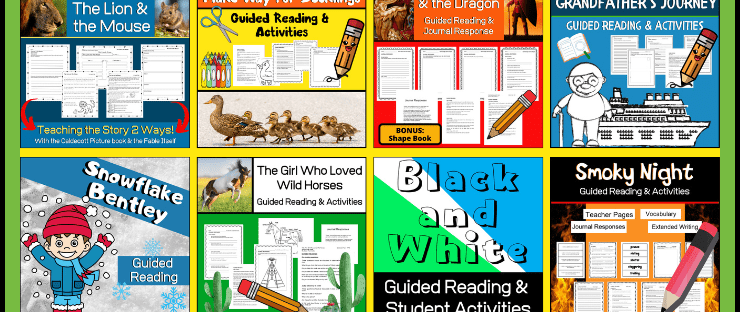
I’ve placed all of these 12 units together in an easy to access: Literature Bundle. Every book included in this bundle is a Caldecott award winning book! 

This BUNDLE offers 12 fun and engaging book units, all offering guided reading questions and student activities designed to increase student interest, test student comprehension, help students use critical thinking skills and explore their creativity.

Included book units:

What can you expect in each of these units? Let me give you one example of what you’ll find in them…

In “The Girl Who Loved Wild Horses“, you’ll find:

For the Teacher: Suggested Pre-ReadingAbout the CoverAfter Reading and About the Artwork questions. What type of questions can you expect? Here are just a few examples of the questions you’ll find… 

  • Pre-reading – What do you think this book will be about? Do you like horses? Why or why not? 
  • After reading – Do you think the storm was just a bad dream or did it really happen? Talk about a bad dream you’ve had and what you did to make yourself feel better. Do you think this story could be true? 
  • About the art – What do the pictures tell you about the time in which the story takes place? Which picture is your favorite?

For the Students:

  • Worksheet for students to answer questions from the story (comprehension and critical thinking)
  • Worksheets to produce questions both while reading and after reading (to engage both during and after)
  • 3 Art responses (emotional and creative response)
  • A poster of horse and label the parts worksheet (going beyond the story)
  • A Teepee shape book to create a book report, a summary; to record and define unfamiliar vocabulary; use to create a poem inspired by the book (from study skills to creative expression)

Here are just a few preview images from a few of the included units:

Not an All-Access member? When you purchase the Literature Bundle, you’ll save 20% off purchasing each individually! 

Need the books for the above units? 
If you do not already have these books, you can go to your local library to borrow them or you can purchase them and have them delivered to your door. The following links will take you to view and purchase on Amazon. My Teaching Library is an Amazon associate:


Join My Teaching Library on social media…

FB Group (PRIVATE GROUP)
FB Page
Pinterest
X (formally twitter)
YouTube

1st grade, Kindergarten, PreK, Reading Instruction

Learning to Read: A “How To” Progression from Letters to CVC Words (Part 2)

In part 1 of this series, I stated a pretty obvious fact…That children must be able to recognize individual letters as the first part of learning to read. However, you also learned that while teaching children letter names, you can (and should) introduce them to the sound each letter makes.

Here, in part 2, I’ll discuss progressing forward to CVC words.

What are CVC words?

It’s important to emphasize the significance of CVC words in early reading education. These three-letter words, comprised of a consonant, a vowel, and another consonant, are pivotal in introducing blending sounds and decoding words to young learners. Mastery of CVC words is essential for the development of phonemic awareness, a fundamental skill for achieving reading success.

Remember, as you taught children to recognize letters, you also taught them to recognize the sound each letter makes. Once they know the letters and sounds, progressing to CVC words is the next step!

To practice blending CVC words effectively, it’s essential to model the process by pointing to each letter and articulating its sound. For example, for the word “cat”. First, say the word. Then, simply start with “c” and make the sound. Next, add the “a” sound followed by the “t” sound. Point to each letter in the word as you make the sound. Once you make each sound separately, say them (blending together) as you once again say the word.

One effective technique that some love to use when teaching CVC words…Placing dots underneath each letter to provide a tactile reference for students. Begin by repeating the process 2-3 times, gradually increasing the pace and seamlessly blending the sounds together until the word is formed.

Following this, encourage students to participate alongside you and eventually attempt the exercise independently. As a beneficial warm-up, start with oral blending before progressing to using actual words on a blending line. With consistent modeling and ample practice, students will develop the ability to independently blend CVC words.

My Teaching Library has a comprehensive bundle designed just for students who are ready to begin learning and practicing CVC words…

LEARN TO READ | CVC BUNDLE

This fun, engaging BUNDLE includes all three CVC workbooks, (short a | short e and i | short o and u), plus a BONUS end of study assessment!

Watch preview videos of each workbook that is included:
– Short A
– Short E and I
– Short O and U

Using this CVC BUNDLE, students will color, trace, write, cut, and glue as they learn and read CVC words!

How to Progress from Letters to CVC Words

Moving from learning individual letters to blending CVC (consonant-vowel-consonant) words is a pivotal milestone in a child’s reading journey. It signifies their transition from recognizing basic phonemes to forming and pronouncing simple words. This phase can be enriched by integrating various engaging activities, interactive games, and providing access to straightforward reading materials. Through a harmonious blend of these approaches, educators and parents can effectively steer young learners towards achieving reading success. Furthermore, cultivating patience, offering consistent encouragement, and fostering a sense of joy in the learning process will lay a sturdy foundation for their future literacy endeavors!


Want to view the TOP SUGGESTED RESOURCES for PreK and Kindergarten students? Click the button below…


My Teaching Library has thousands of digital downloads ready to use!
Curriculum, Units, Worksheets, Posters, Activities…and more.

On My Teaching Library, YOU CHOOSE!

Purchase resources individually or…

Kindergarten, PreK, Reading Instruction

Learning to Read: A “How To” Progression from Letters to CVC Words (Part 1)

Reading is a crucial skill that begins by mastering the alphabet. However, as students progress, they encounter another milestone in their journey – the transition from recognizing individual letters to seamlessly blending consonant-vowel-consonant (CVC) words. This is an essential step that helps them decode and read more complex words. In this series, I will share a step-by-step guide on how you can help your students make this transition effectively.

In this blog post, part 1, I’m addressing the skill of mastering letter recognition.

Learning to Recognize Letters

Students must be able to recognize individual letters before introducing them to mixing CVC words and thus beginning to read.

  • Students should be able to recognize both capital and lowercase letters in order to be proficient in letter recognition.
  • Identify the various print fonts (consider the numerous ways to write an or g).
  • Have rapid and accurate sight letter recognition.

Some practice ideas if a student isn’t recognizing at least half of the alphabet’s letters…Reinforce letter recognition with fun activities including worksheets, flashcards, and alphabet games.

Need resources to help teach letter recognition? My Teaching Library has a great variety…

Go to: ABCS TRACE AND COLOR 
Free to All-Access Members
Non-Members will find listed price on product page

Go to: LETTER LAPBOOKS | A-Z
Free to All-Access Members
Non-Members will find listed price on product page

Go to: LETTER LEARNING A-Z CAPITAL LETTERS | INTERACTIVE COLOR, CUT AND PASTE
Free to All-Access Members
Non-Members will find listed price on product page

Go to: MORNING WORK FOR KINDERGARTEN | 1ST SEMESTER
Free to All-Access Members
Non-Members will find listed price on product page

Go to: MORNING WORK FOR KINDERGARTEN | 2ND SEMESTER
Free to All-Access Members
Non-Members will find listed price on product page

It’s crucial to understand that letter recognition is just one component of the process of enabling students to blend. Acknowledging the need for students to recognize a minimum of 50% of the alphabet’s letters before progressing is essential. This criterion is vital because students could potentially advance to blending at a faster pace than anticipated. Once students grasp letters and their respective sounds (for example, m, a, p, s, t), they are ready to begin blending!

As you practice letter recognition, it’s important to introduce the sounds associated with each letter. As students learn each letter, say when they are completing a lapbook for each letter or working on a letter page, you can you can say, “The letter b makes the /b/ sound heard at the beginning of ball or big.”

Encourage the students to repeat after you or complete the sentence, such as, “this is the letter __ ‘b!It makes the __ ‘/b/’ sound”. This brief daily exercise will help your students learn both the letter names and sounds simultaneously!

It is also always helpful to use multisensory approaches, such as associating sounds with gestures or using tactile materials, to enhance understanding!

Continue reading…PART 2!


Want to view the TOP SUGGESTED RESOURCES for PreK and Kindergarten students? Click the button below…


My Teaching Library has thousands of digital downloads ready to use!
Curriculum, Units, Worksheets, Posters, Activities…and more.

On My Teaching Library, YOU CHOOSE!

Purchase resources individually or…
Pay ONE PRICE and get ALL the PRINTABLES you need in ONE PLACE with ALL-ACCESS