
Book Units, BUNDLES

Why and How to Add “Little House on the Prairie” Books to your Homeschool lesson plans
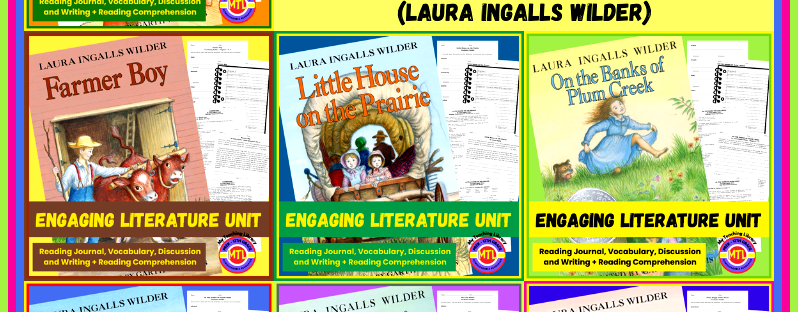
If you are teaching 3rd-6th grades, want to teach good chapter books with wholesome messages, these literature units are for YOU! With over 400+ pages in the BUNDLE, you can easily plan to cover an entire year. 

Why read “Little House” books? 

  • Educational Value: The series covers a wide range of topics, including history, science, home economics, and the importance of hard work and perseverance. It can be used to teach children about the challenges and triumphs of life in the past. 
  • Wholesome Values: The books instill positive values such as cooperation, responsibility, and the importance of family. They also highlight the sacrifices made by families to build a better life. 
  • Historical Context: The series provides a window into the lives of early American settlers, offering insights into the culture, traditions, and daily life of the time. 
  • Personal Connection: Many readers find a personal connection to the stories, as they relate to their own experiences or the experiences of their families. The series can evoke memories and emotions that resonate with readers of all ages. 
  • Timeless Appeal: The “Little House” books have stood the test of time, remaining relevant and enjoyable for new generations of readers. They continue to inspire and entertain, making them a must-read for anyone interested in American history and literature. 

In summary, the “Little House” series is not just a collection of stories about a family’s journey westward; it is a rich tapestry of life lessons, historical context, and personal connection that continues to captivate readers of all ages. 

How to add these wonderful books to your lessons
My Teaching Library has created a BUNDLE of units to give you what you need…Easy to use, just print and go!

About the Bundle:

Included in this BUNDLE are full literature units for…

  1. Little House on the Prairie
  2. The Long Winter
  3. Farmer Boy
  4. These Happy Golden Years
  5. Little House in the Big Woods
  6. By the Shores of Silver Lake
  7. On the Banks of Plum Creek

400+ pages in total

Each unit includes:

  • Vocabulary work – Students are asked to find and write a definition, an antonym and a synonym for each word given.
  • Reading journal for every chapter in every book
  • Reading comprehension quizzes (including keys)
  • Essay questions – Many will ask students not only about events in each book but also ask students to relate events to their own lives in some way.
  • Oral discussion questions – Perfect for large or small groups (literature circle) discussions – Great for both Co-ops and one on one parent interaction.

Not sure if you want the entire bundle? Each unit is available for individually purchase, however you’ll save $7.50 when you purchase the bundle! (Unless, of course, you are an All-Access members. Everything is FREE with All-Access!)

Here are the individual units:

  1. Little House on the Prairie Literature Unit | Laura Ingalls Wilder
  2. The Long Winter Literature Unit | Laura Ingalls Wilder
  3. Farmer Boy Literature Unit | Laura Ingalls Wilder
  4. These Happy Golden Years Literature Unit | Laura Ingalls Wilder
  5. On the Banks of Plum Creek Book Literature Unit | Laura Ingalls Wilder
  6. Little House in the Big Woods Literature Unit | Laura Ingalls Wilder
  7. By the Shores of Silver Lake Literature Unit | Laura Ingalls Wilder

Have you been considering getting All-Access? 
Check out what others are saying…

All-Access members do not pay for this or any resource. Become an All-Access member today!

________________________

Get the MOST from My Teaching Library by connecting with us here:
FB Group (PRIVATE GROUP)
FB Page
Instagram
Pinterest
X (formally twitter)
YouTube
10th Grade, 11th Grade, 12th Grade, 9th Grade, High School, Literature Connections

Pride and Prejudice – Why Teach this Novel?

Brief story overview: Set in England in the early 19th century, Pride and Prejudice tells the story of Mr and Mrs Bennet’s five unmarried daughters after the arrival of the rich and eligible Mr Bingley, and his status-conscious friend, Mr Darcy, in their village. While Bingley takes an immediate liking to the eldest Bennet daughter, Jane, Darcy has difficulty adapting to local society and repeatedly clashes with the second-eldest Bennet daughter, Elizabeth. It is an 1813 romantic novel of manners written by Jane Austen and follows the character development of Elizabeth Bennet, the dynamic protagonist of the book who learns about the repercussions of hasty judgments and comes to appreciate the difference between superficial goodness and actual goodness. Its humor lies in its honest depiction of manners, education, marriage, and money during the Regency era in Great Britain.

“I am amusing myself with Miss Austen’s [sic] novels. She has great power and discrimination in delineating common-place people; and her writings are a capital picture of real life, with all the little wheels and machinery laid bare like a patent clock.”

—Henry Wadsworth Longfellow, Journal entry, May 23, 1839

So why have students read this 19th century novel?

I could give you several reasons that seem to be ‘literary learning’ in nature such as…

  • To study the author’s use of satire and irony as well as many other literary devices
  • The novel has a strong female protagonist and thus a study of her role would lead to rich discussion
  • The ability to make strong contrasts between characters and how Austen builds our knowledge of each
  • To find and study the many themes of the novel and how these themes relate to students’ lives today

…and while all of these would be true, that’s not what I’m going to do. Instead I’m simply going to highlight several ‘life lessons’ that can be learned while reading and examining the story and characters.

Lessons which can be learned while reading Pride and Prejudice

Pride and Prejudice

1. It’s okay not to be good at everything.

Elizabeth Bennet, the novel’s heroine, is interesting not because she’s good at everything, but precisely because she isn’t. She and her eventual husband, Mr. Darcy, have a conversation early in the novel about what defines an “accomplished” woman.  Darcy indicates that such a lady would be able to play music, sing, dance, draw, speak several languages, and read frequently.  Rather than pretend she possesses these qualities—or feel ashamed that she doesn’t—Elizabeth accepts who she is.

Elizabeth replaces exhausting exceptionalism with passion.  There are certain things that she is passionate about—reading, her family, travel—that make her unique and, in fact, endear her to Mr. Darcy.

As you teach this novel, point out this fact to students to remember that it’s okay not to be good at everything and life is a learning process. Have them take time to reflect on (and try to discover) the passions and qualities that make each of them unique.

2. Don’t make snap judgments.

This is the obvious lesson of the novel—don’t judge the proverbial book by its cover.  This lesson is as important as ever in today’s society.  Remind students not to let their first impressions dictate how they feel about people, ideas or even activities. Don’t shy away from something because you fear it—try to view it from a different perspective. Ask them to allow others to surprise them! To keep an open mind as they might find that people may contradict the image they first presented to them.

3.  The importance of planning.

In this easily-readable novel, Ms. Austen underscores the importance of planning.  Pride and Prejudice as perfectly-structured a novel as ever was written: from the initial tension in Elizabeth and Darcy’s meeting to the disastrous anticlimax of the first proposal, the upward trajectory of Elizabeth’s feelings for the man she’d judged poorly, Darcy’s climactic saving of the Bennet family’s reputation, and his subsequent successful proposal of marriage to Elizabeth, the novel moves quickly and deliberately in precisely-plotted chapters.  Austen wastes no time with frivolous details: everything ties together; each scene has a purpose.

Ask students to take a page from Austen’s book as they plan both in school and in life.  Careful preparation can lead to great success!

4. A little humor goes a long way.

Despite the beliefs of some, Pride and Prejudice is not just Victorian chick book.  It’s a romantic tale with a marriage plot, to be sure, but it’s also a comedy.  From the sycophantic Mr. Collins to the drily sarcastic Mr. Bennet, the novel is filled with jokes, little nods from Austen to the reader.  The book is really funny.

Pride and Prejudice Novel Study
Complete novel study for Jane Austen’s Pride and Prejudice (196 pages). Includes:
– Author’s Biography
– Novel Introduction
– Characters and Themes
– Quotes and Analysis
– Teaching Guides dividing the novel into 5 sections w/
* Chapter Summaries, Thought Questions and Vocabulary
* Student Handouts
* Student Worksheets, Assessments & Keys
– Final Assessments

Pride and Prejudice Vocabulary Study
Complete novel study for Jane Austen’s Pride and Prejudice (196 pages). Includes:
– Author’s Biography
– Novel Introduction
– Characters and Themes
– Quotes and Analysis
– Teaching Guides dividing the novel into 5 sections w/
* Chapter Summaries, Thought Questions and Vocabulary
* Student Handouts
* Student Worksheets, Assessments & Keys
– Final Assessments

Pride and Prejudice | Assessments
Looking for only a way to test student reading comprehension and understanding as they read Jane Austen’s Pride and Prejudice? The resource will give you 5 quizzes for students to take while reading the novel and then after they have completed the entire novel, an essay assessment as well as a 20 question, multiple choice test. Answer Keys included!

Need a copy of the book itself?

Pride and Prejudice (Jane Austen)

If you’d like a FREE PREVIEW of what you’ll get if you download the Pride and Prejudice Novel Study, simply click here to instantly download a preview.

________________________

>> Learn more about My Teaching Library! <<