Homeschool, Planning

Plan your Homeschool Year like a Pro!

Plan like a pro using this each to follow checklist…

1. Plan & Organize

  • Know your state’s homeschooling requirements and update all necessary documentation. You’ll find requirements for each state here: HSLDA.org
  • Establish goals for your child(ren), academic objectives, personal development, and life skills. I encourage you to engage your child(ren) in this process. Ask for their input regarding desired accomplishments, areas of interest, and subjects requiring further attention.  I have goal planning forms inside our Mega-Planner. If you need short term goal sheets for a child with ADHD, you can find them here.
  • Develop a comprehensive schedule and routine for the first month, including planned breaks. When doing so, know that you should expect to be flexible. The beauty of homeschooling is that life happens and you can adjust!
  • Consider multiple methods, such as thematic units, weekly segments, subject-based planning, or conceptual frameworks. Keeping different methods within your plans will help your child(ren) to stay engaged and excited.
  • Organize curriculum materials and print any required worksheets or planners. Utilize binders or other organizational tools; ensure adequate printer supplies are available. Want school supply recommendations? I’ve got them here!
  • Establish a flexible daily or weekly routine. A flexible mindset is key when homeschooling!
  • Download the Mega-Planner to help get and stay organized.      

2. Prepare Your Learning Environment

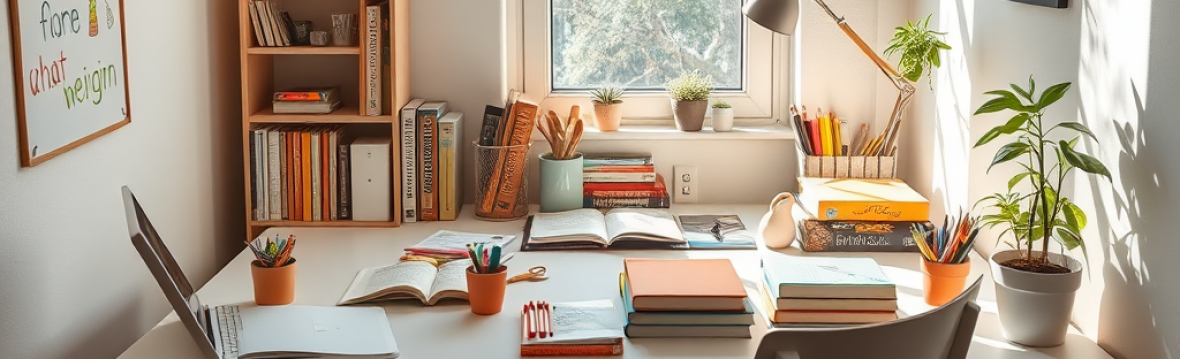
  • Declutter and update the homeschool area to create a conducive learning space. Remove unused books, outdated worksheets, and expired supplies from the previous year.
  • Acquire essential school supplies, including writing instruments, notebooks, and art materials.
  • Implement a storage solution for instructional resources and completed student work.
  • Post a visual schedule or morning overview to clarify daily expectations.

3. Gather & Inventory Curriculum

4. Set Up the Academic Calendar

  • Record critical dates that you want to plan around such as holidays, co-op meetings, and field trips. For families homeschooling year-round, advanced planning of breaks and excursions ensures goal attainment. Calendars can be found in our Mega-Planner.
  • Schedule regular planning or “teacher days” to review progress and evaluate the effectiveness of curriculum and methodologies, making adjustments as needed.

5. Foster Enthusiasm in Students

  • Design and implement an engaging activity or tradition for the first day of the homeschool year.
  • Prepare a back-to-school kit with new supplies or a small token to mark the occasion.
  • Discuss goals and interests with each student to tailor learning experiences accordingly.

6. Prepare Yourself as the Instructor

  • Reflect on previous years’ successes and challenges, incorporating feedback from your child(ren) regarding preferred resources, activities, and areas for improvement.
  • Develop a self-care strategy to prevent burnout, prioritizing periodic breaks. This is very important! 😉
  • Join the My Teaching Library fb group for support.

7. Final Steps

  • Create a list of potential field trips and hands-on projects to enrich the curriculum.
    Download your Field Trip Advance Planning Forms here and your child(ren)’s after field trip forms here.
  • (When possible) Prepare meals in advance to facilitate low-stress school days. Also, remember to incorporate recipe planning and cooking within your homeschool plans from time to time. These activities are learning activities! Download our colorful recipe templates to use for planning.
  • Maintain adaptability throughout the year! Remember to stay flexible. Burn out is real and your child(ren) can feel it too. Learning is a journey, not a race!  


My Teaching Library – A teacher and parent recommended, comprehensive site, offering you flexible, child-centered materials for all core subjects PreK-12th grade! With My Teaching Library, YOU are in control. You control what and how you teach your children as well as how you access the resources.

What and how: Instead of a one-size-fits-all curriculum, you’ll have instant access to educational materials designed to give you choices! You select what you want to use, and when you want to use it. Why? Because every child learns at their own pace and through their own unique learning style.

How you access: You decide if you want to purchase resources individually or save by becoming an All-Access member.

What are members saying about My Teaching Library?

 “I’d say My Teaching Library is about saving time and sanity. This is a well-organized site that is just brimming with resources for every grade level and subject…. Everything feels like it’s right there are your fingertips just waiting to be accessed…

You can easily plan your entire homeschool year using just My Teaching Library alone with all the teaching supplies and homeschooling magic you can make! These are the only homeschool educational resources you need – really!… By now, it’s not hard to conclude that I am a huge My Teaching Library fan. I will always be a member because they offer so many great teaching resources for homeschool!”

My Teaching Library…The premier choice for thousands of homeschooling families!   

Homeschool

Online vs Offline Homeschooling: Which is Better?

Make an Informed Decision: Online versus Offline

Regardless of why you chose homeschooling, if you are reading this, you are curious which is the best way to homeschool.

With the ease of today’s digital world combined with the daily demands of life, online homeschooling seems a no brainer, especially given the top reasons why parents say they’ve chosen to use an online program:

– I’m not a teacher.
– I don’t have time to prep and plan.
– I have a job and don’t have time.
– I have other kiddos running around

Hi, I’m Lynda Ackert and I’ve been in education for over 30 years. I’ve taught in public school and was a full-time homeschooling momma (PreK-12th grade). Homeschooling is one of the best decisions I’ve ever made…and I’ve done it all, both online and offline.

I’ve learned a lot…but to truly help YOU see the difference, and not just rely on my experience and opinions, I’d like to present you with facts borne out from research. (I’ve included the sources at the bottom of this page.)

After I present the facts, I’ll share more of my own thoughts.

Should You Use an Online Program or Stay Offline (Using Physical Materials)?

RESEARCH FINDINGS:

Engagement and Focus

Online: The collective research shows that digital media have common features and user practices that can constrain learning. These include diminished concentration, an entertainment mindset, a propensity to multitask, lack of a fixed physical reference point, reduced use of annotation, and less frequent reviewing of what has been read, heard, or viewed,” said linguistics professor Naomi S. Baron, in How We Read Now.

Students tend to associate technology with entertainment and are far less likely to give the material the attention and focus needed. They are more likely to multitask, skim text, and refrain from engaging with the material.

Offline: When students can learn with their own print materials, they focus better and concentrate on what they are doing.

Print-based learning is not as linked with entertainment, contains far fewer distractions, and allows students to physically engage with the material through annotation, writing, and drawing – helping students stay on task.

Deep Understanding & Long-Term Retention

Online: Students learn less and do not retain the materials as well. Research shows that there are less brain connections made using online, digital learning methods. (WOW! This is HUGE!)

Offline: Students learn more using physical materials. Their understandingcomprehension, and retention were higher when reading print than when reading the same text on a screen or even listening to or viewing the material.

Students who read the material in print were also more successful at identifying main ideas, recalling specific details, correctly remembering sequencing, and completing abstract tasks like drawing inferences. Additionally, students of all ages who had read the material in print scored higher on assessments than their peers who had used digital learning!

The physical properties of paper also account in part for its superior effect on learning. The visual geography of paper has memory-linking effects that help students connect what they have read with where they saw it on a page or how far into a book it was.

Using paper in the classroom also aids learning because students can write on, draw on, and annotate their materials. Research done by experts in memory suggests that drawing, in particular, can strongly affect recollection, and is an effective learning tool.

Ownership Equals Self Confidence

Online:  When using online platforms, students are far less invested in their work. They have no tangible ‘products’ that are produced and thus the self-confidence that comes from creating and producing tangible materials isn’t possible.

Offline: When students have a print copy to work with and/or make their own, it helps them feel like they are in charge of their own learning. This increases their self-confidence and their investment in their own journey of learning.

When students have physical, consumable materials, they are more engaged! They can highlight, underline, write notes (physically writing is proven to be superior to typing in retention and making brain connections), cutting, pasting, physically manipulating and creating ‘owned’ masterpieces, projects, essays, etc.

When students write and create, they own their learning, articulate their thinking, and tap into creativity and organizational thinking skills. These student created materials (even their ‘notes’) help students understand what they are working on and encourage them to connect old and new knowledge. (BRAIN CONNECTIONS!) As students physically create artifacts, they visibly represent their thinking, understanding, and skills.

You’ve chosen to homeschool because you want the very best for your child. You and I both know that every child is unique. So, I’m going to be real here…Online programs are made for the masses. Even if the program is self-paced, the actual content can’t be changed. The order and material is set.

If you stay offline and use physical resources (books and printouts), you can tailor the materials to fit your individual child. If they show interest in a specific topic, delve deeper. If a your child isn’t grasping a topic at a given moment, you can elect to move forward (skipping that topic for a bit) and go back later when you feel they are ready. I could go on and on here about life circumstances, abilities, learning styles…but you get the idea.

Moving Past the Daunting Pause – Choosing To Stay Offline
Yes, it can be daunting to be your child’s primary teacher.
The time, the effort, the feelings of inadequacy.
It’s worth it!

Remember three things: 

1.  Homeschooling isn’t an 8 hour a day thing. If your state law requires 8 hours of ‘schooling’ a day, that doesn’t mean you sit down and teach for 8 hours! The typical homeschooling day takes between 2 – 4 hours, 3 to 5 days a week. That’s it! If you have a kindergartener, it probably will only be an hour and that doesn’t have to be all at one sitting.

Adding up educational hours: You can count daily life activities as learning! Here are things that you can record to be educational learning activities: chores, cooking, grocery shopping, gardening, visits to a museum, swim class… you get the idea!

2. Noone will ever know your child, love your child as much as YOU. Ask yourself, how are you going to know, REALLY KNOW, what your child is learning and/or struggling with if you aren’t in the ‘trenches’, taking the time to observe, ask questions, delve into their learning?

Yes, online learning platforms will provide you with reports on skills learned but those reports can’t give you any insight into the ‘whys’ behind the results. Also, these programs (and reports) can never indicate nor assess your child’s ability to think beyond rote learning.

Online Platform Reports Can and Cannot Provide:

They can tell you…
– If your child can recall a facts and choose correct answers from a given set of answers about a reading passage and or video.

– If your child can answer math problems correctly

– What grade level skills your child seems to have “mastered” (…but haev lasting connections been made? Will the skills be retained? Research has shown that students who learn via printed materials score higher overall on mid-year, end-of year, grade level tests.)

What they cannot tell you…
– Why your child is not grasping a concept or recalling facts. Was he rushing through the reading? Did he read the passage fully? Can he read and understand all of the words in a passage? If you are using physical, offline resources and your child isn’t grasping or recalling what is in a passage, you can sit down with your child and delve deeper. Read with him. Ask him questions. Help him make connections he isn’t making.

– What mistakes or misunderstandings are happening causing your child to incorrectly answer math problems. A computer or video program is not able to sit side-by-side to watch your child go through the steps. You can. You can also help guide through asking questions. What is his reasoning?

– If your child can apply, think critically about, or extend the learning beyond the presented material. This requires questions to be asked, discussions to take place, projects to be created. What I mean is this…A online program’s report of your child’s abilities will never be able to tell you if your child can differentiate, organize, or examine the topic further. Can your child successfully appraise, argue, defend a ideas/topics? Can your child develop ideas further, investigate, and construct a way to do so.

What about an ‘online’ teacher? 
Unless you are paying for one-on-one instruction, realize that that online classes have multiple children in each class and are teaching over a ‘zoom-like’ setting. They can’t see everything that is happening, nor can they slow down or speed up based on one child’s (your child’s) needs. Because they have a set program, they can’t stop, delve deeper nor go on extended rabbit trails of learning that your child may benefit greatly from. After classrooms closed during 2020-2021 and were forced to hold classes via zoom, much research has proven the downfalls of this type of learning!

3. Homeschooling is a journey, not a race…and it’s a GIFT you’ll never regret! One of the BEST things I enjoyed as a homeschooling momma was the amount of quality time I had with my child. If you choose to use physical materials, stay offline and remain your child’s primary teacher, that time is precious quality time. Fleeting time. Time you will cherish in years to come!

You’re there at every twist and turn, witnessing and walking with your child through every aspect of the journey. As I mentioned previously, I did choose to use online programs a couple times. One year I chose a video driven curriculum and once I used an online classroom with a live teacher. Not choices I would ever make again.

As a homeschooling parent, when I was fully engaged, there was rarely a day that went by that I didn’t have the opportunity to encourage my child when he faced frustration, model appropriate character-building behaviors, or just listen, truly listen to my child’s heart when he needed it.

Embrace the Journey!

~ Lynda

Do you have questions about how you can homeschool using My Teaching Library?

Learn more:

What Makes My Teaching Library Different?

Sample Previews of My Teaching Library Products!

My Teaching Library All-Access Membership