Uncategorized

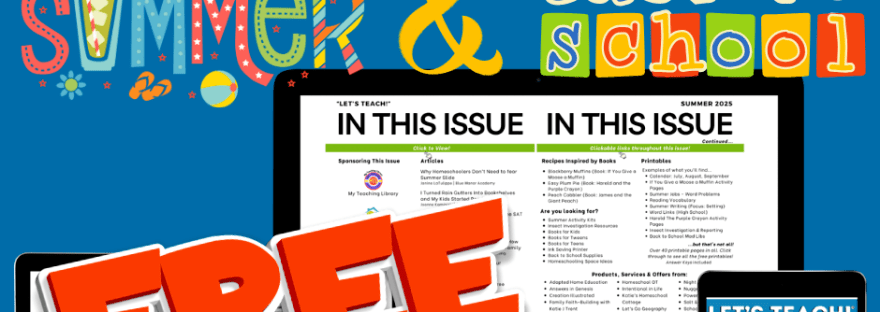
Free Summer 2025 Homeschooling eZine: Download Now!

“Let’s Teach!” eZine – Summer 2025 

The Summer and Back-to-School themed issue is available to read online and download, all for free!  

Get your FREE COPY HERE: https://myteachinglibrary.com/ezine/

Why is “Let’s Teach!” @Home eZine a favorite of tens of thousands of homeschooling familiesEvery issue is jam-packed with homeschooling advice, information, discounts and freebies from homeschool providers who want you and your children to flourish!

IN THIS ISSUE:

300+ Pages of FREE resources

  • 40+ pages ready to print directly from the eZine
  • Copy of “The 4 Pillars of Teaching a Special Needs Child”  
  • 200+ page “Homeschool Mom’s Survival Kit”
  • Report Card Template
  • 10-week Bible Study eCourse
  • U.S.A. State Geography sampler of 10 states
  • Geography Craft
  • “Brainstorming for a 5 Paragraph Essay” video lesson
  • “Easy Summer Learning Plan” printables and video workshop
  • Lesson “How to Handle Changing Emotions in Your Tween Girl”
  • 15-page pack “Cultivate the Love of Learning in Your Home”
  • “Picture Books that Teach! Executive Function” List
  • 44 pages of hands-on unplugged coding fun
  • 1-month faith and character-building copywork
  • “Ways to Keep Your Preschooler Busy”
  • Access to “Plan a Successful Homeschool Year in 5 Easy Steps”
  • “Writing Numbers with the 10 Commandments”

Discover time-sensitive discounts on exceptional products and services, ranging from 10% to 75% off.

Read informative articles from homeschooling experts and parents:

  • Why Homeschoolers Don’t Need to Fear Summer Slide
  • I Turned Rain Gutters Into Bookshelves and My Kids Started Reading More
  • Why Homeschoolers Should Take the SAT or ACT in a Test-Optional College Admissions World
  • Summer Break or Summer Growth? How to Find the Right Balance for Your Family
  • Why Read-Alouds Matter in Your Homeschool Day
  • Unplugged Coding: A Screen-Free Approach to Teaching Kids
  • Teach Writing Painlessly in a Homeschool Co-op

Find helpful suggestions

  • Books for Kids
  • Books for Tweens
  • Books for Teens
  • Summer Fun Kits
  • Ink-saving Printer
  • School Supplies
  • Homeschooling Space Ideas

Get 3 fun, kid-friendly recipes inspired by children’s books.

You’ll want to read this issue cover to cover…and make sure to download your copy to keep, it’s FREE! 

Share “Let’s Teach!” with everyone homeschooling family you know so they can get their FREE COPY too.  

Get your FREE COPY HERE: https://myteachinglibrary.com/ezine/ 


Uncategorized

Creative Sand Art for Family Fun

So, what exactly is sand art? It’s a fascinating form of art where you use sand to create designs or images on a surface, transforming a simple medium into a powerful method of expression! Sound like something full of FAMILY FUN?!

Think of it like painting, but with grains of sand serving as an artistic medium to bring the imagination to life. You can create anything from simple shapes that capture the essence of everyday objects to intricate landscapes that tell a story or evoke emotions…and that’s why this is truly something for ALL AGES and ALL MEMBERS of your family!

The texture and color of the sand can vary greatly, allowing for endless combinations and techniques that can enhance artistic vision. Whether someone prefers working on a small scale, creating delicate patterns in a bottle, or on a large scale, sculpting breathtaking scenes on the beach, sand art caters to all forms of creativity.

You can use containers to create sand art, but for this article I’m going to give directions for creating sand art on a canvas!

Materials You’ll Need:

  • A canvas (any size you prefer)
  • Fine-grained sand (available at craft stores or hardware stores)
  • Acrylic paints in your desired colors
  • Paintbrushes
  • Toothpicks
  • A palette
  • A cup of water
  • All-purpose glue

Step-by-Step:

  1. Sketch Your Design: Start by lightly sketching your desired design onto the canvas. This can be anything from simple shapes to intricate landscapes.
  2. Apply the Adhesive: Using a paintbrush, apply a thin layer of your preferred adhesive to the areas where you want the sand to adhere.
  3. Pour the Sand: Gently pour the sand onto the adhesive-coated areas. Make sure the sand is evenly distributed and covers the entire design.
  4. Press the Sand: Use your fingers or a spoon to gently press the sand into the adhesive. This will help secure the sand to the canvas.
  5. Dust Off Excess Sand: Tilt the canvas and tap on the edge to gently dust away the excess sand that has not adhered to the canvas.
  6. Shape the Sand: Use a toothpick to shape and refine the details of your sand art design.
  7. Remove Excess Sand: If there are any areas where too much sand has accumulated, use a toothpick to carefully remove the excess.
  8. Paint Your Creation: Once the sand is secure, use acrylic paints to add color your sand art. You can use a variety of techniques, such as stippling, blending, or layering, to create different effects.
  9. Let It Dry: Allow the paint to dry completely before handling or displaying your sand art piece.

Tips for Success

  • Experiment with different colors and textures.
  • Don’t be afraid to make mistakes. Sand art is a forgiving medium, so you can easily correct any errors.
  • Have fun and be creative! Sand art is a great way to express yourself and relax.

Sand art is an enjoyable and easy way to make unique art pieces for and by your entire family! By following a few simple steps, everyone can create sand art. The most important part is to experiment, enjoy, and let creativity abound!!


Thank you for visiting and reading this post from My Teaching Library!

My Teaching Library is a family-owned business started by a mom (and now grandma) with over 30 years of experience in the field of education. Having worked as a public-school teacher prior to becoming a full-time homeshcooling mom, Lynda has experience from both perspectives and is dedicated to creating and sharing with YOU the very best resources to help you teach your children. In an effort to help you SAVE TIME and MONEY as a teacher and homeschooling parent.

To save you time, she has created and gathered thousands of resources now available to you for instant download all on one site, MyTeachingLibrary.com. It is also important to her that children are taught as the unique learners that they areLearn the My Teaching Library difference.

To save you money, she offers two ALL-ACCESS membership plans. Members do not pay listed prices, instead they only pay for membership!

Join Lynda and My Teaching Library on social media…
FB Group
FB Page
Pinterest
X (formally twitter)
YouTube

Uncategorized

Unlocking Your Child’s Success: Beyond the Curriculum

Giving your child the BEST chance to succeedKey’s to Unlock Success!

As parents and teachers, we want to give our children the very best education possible. We want them to succeed. We spend hours (sometimes years) searching for the perfect curriculum and often spend a lot of money on what we believe will give them the greatest opportunity to learn and succeed.

…but is it all about the curriculum?

Going Beyond the Curriculum

This may seem a little crazy from someone who creates and sells curriculum to tell you that it really isn’t the curriculum that matters. There is much more at play than just choosing the right curriculum and whether the information in the curriculum will actually ‘stick’ …Will your child retain the information?

I want to introduce you to a term you may (or may not) have heard of…Brain-Based Learning.

Brain-Based Learning

I could probably write many lengthy posts on brain-based learning, but I don’t believe you need to get too deep into the science of it all to be able to help your child get the very most out of their learning, to begin retaining the information they are learning and to have the very best chance to succeed.

Here are some key points:

Health
I’m sure you are already very aware of this first part, but I since I’m writing this article, I need to include it…Regardless of a student’s age, they need to be well rested, eat good, nutritional meals and given ample opportunities to ‘use’ their bodies throughout the day. Students need a lot of physical activity, movement, stretch breaks, etc. to be (and stay) engaged with their curriculum.  

Attitude
A student’s attitude and emotional state during learning is vital to learning and retaining what is learned. Positive affirmations and limited criticism will help a child’s self-esteem which will affect their ability to learn. Give critiques not criticisms. Give positive, constructive critiques by stating what is done well, recognizing improvements, being specific in the area being address (not broad), express appreciation and end on a positive note. Be your child’s cheerleader and encourage positive, growth mindset!

Senses
During the learning process, the more senses one uses, the more “brain connections” that can and will be made! The brain processes information through multiple senses so incorporating visual, auditory and kinesthetic elements are key. It can be very easy to sit our children in front of a computer or hand them a workbook but always ask yourself, “Are there a good variety of visual, auditory and kinesthetic activities involved?” If not, look for ways to add them!

Also, what about the learning environment and your child’s senses? Can your child’s environment make a difference in successful learning? For many children, the answer is yes! For some, light, sound and temperature of the learning space can be a factor. So, don’t forget to consider all aspects of your child’s learning environment.

Relevant
Making what a student is learning relevant to their lives and interests will increase motivation, engagement and long-term retention. Connecting new information to existing knowledge and experiences help the brain make meaningful and lasting connections. Whenever (and however) you can, get your child to apply what they are learning to relevant, real-life situations. In other words, how can they think about or apply what they are learning to their ‘real life’?

Connections
When I write the word ‘connections’ here, I’m referring to making brain-connections through connecting with others around them. When a child connects with others, while learning, or after learning (sharing what have learned), they are helping their mind connect and create new pathways within the brain. This can be through cooperative learning activities, reading to others (siblings, parent, grandparents), teaching or presenting what they’ve learned, etc. If you are teaching a single child and they do not have the opportunity to work in a small group or peer teach, get creative! Have them create a ‘teaching’ video or perhaps puzzles that others could use.

Layered-Learning
This is vital! Not familiar with layered learning? Even if you do everything above, for your child to get the very most from their education, layered-learning is a must! Read more on My Teaching Library here: Layered Learning


Thank you for visiting and reading this post from
My Teaching Library!

My Teaching Library is a family-owned business started by a mom (and now grandma) with over 30 years of experience in the field of education. Having worked as a public-school teacher prior to becoming a full-time homeshcooling mom, Lynda has experience from both perspectives and is dedicated to creating and sharing with YOU the very best resources to help you teach your children. In an effort to help you SAVE TIME and MONEY as a teacher and homeschooling parent.

To save you time, she has created and gathered thousands of resources now available to you for instant download all on one site, MyTeachingLibrary.com. It is also important to her that children are taught as the unique learners that they areLearn the My Teaching Library difference.

To save you money, she offers two ALL-ACCESS membership plans. Members do not pay listed prices, instead they only pay for membership!

Join Lynda and My Teaching Library on social media…
FB Group
FB Page
Pinterest
X (formally twitter)
YouTube

Literature Connections, Uncategorized

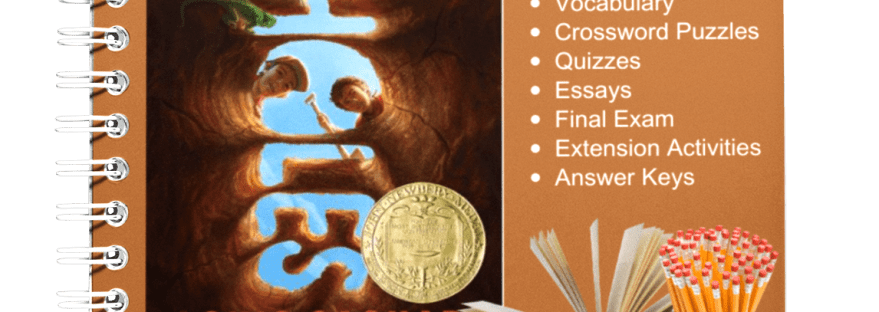
Holes Advanced Novel Study: Literary Elements, Analysis, and More

This is an in-depth novel study of Louis Sachar’s Holes in which students will delve into literary elements of the book, analyze various topics and themes, write arguments and opinions, conduct research and more! This unit is designed for advanced 6th-8th graders and High School students.

Sections of this 112 page study include:
– Summary
– Metaphors and Similes
– Irony
– Imagery
– Fairy Tale Elements
– Literary Elements
Lesson Plans
– About the Author
– Key Aspects
– Part 1 (Chapters 1-9)
– Part 2 (Chapters 10-20)
– Part 3 (Chapters 21-30)
– Part 4 (Chapters 31-40)
– Part 5 (Chapters 41-50)
Final Essays
– Essay Suggested Questions
– Grading Rubric
– Final Essay Answer Key
Final Exam
– Answer Key
Optional Extension Activities


Thank you for visiting and reading this post from My Teaching Library!

My Teaching Library is a family-owned business started by a mom (and now grandma) with over 30 years of experience in the field of education. Having worked as a public-school teacher prior to becoming a full-time homeshcooling mom, Lynda has experience from both perspectives and is dedicated to creating and sharing with YOU the very best resources to help you teach your children. In an effort to help you SAVE TIME and MONEY as a teacher and homeschooling parent.

To save you time, she has created and gathered thousands of resources now available to you for instant download all on one site, MyTeachingLibrary.com. It is also important to her that children are taught as the unique learners that they areLearn the My Teaching Library difference.

To save you money, she offers two ALL-ACCESS membership plans. Members do not pay listed prices, instead they only pay for membership!

Join Lynda and My Teaching Library on social media…
FB Group
FB Page
Pinterest
X (formally twitter)
YouTube

Discounts, Homeschool, Parenting, Uncategorized

Educational Discounts for Homeschooling Families

Did you know that homeschooling parents are entitled to receive discounts offered to public school teachers or private tutors!

To get these discount, you will need some physical proof you are a teacher before going to a business and asking for an educator discount. You don’t have to pay for and educator ID because if you have a computer and printer, you can create your own with a free download from My Teaching Library!

What Types of Businesses May Offer Teacher Discounts…

Homeschoolers have asked and received discounts at all sorts of places of business:

  • Arts & Crafts
  • Bookstores
  • Catalog Suppliers of all sorts of things
  • Computer Stores (computer hardware and software for teacher & students)
  • Craft Supply Stores
  • Furniture Stores (student desks & chairs)
  • General Merchandise
  • Hardware Stores (For all those bookshelves and projects)
  • Museums
  • Music Stores
  • Office Supply
  • Science Stores
  • Sporting goods

If you do not already know that an educator discount is offered, who do you ask? When you go to a place of business, ask for the general manager or for the sales person in charge of corporate accounts at larger businesses. Ask that person if they give an “educators’ discount” BEFORE you tell them you are a homeschooler. A “yes” answer will give them less room to wiggle out once you do tell them you homeschool. If they say “yes,” tell them you are a homeschool educator (No need to go into great detail.) and you’d like to apply to get an educators’ discount.

What You Will Need

You will definitely need an educator ID card that proves you are a teacher. You can create one easily on your computer with My Teaching Library’s FREE Homeschool ID resource!

  • Download your template and open it with a pdf program. Then, click on each section to type in your information. Next, click on the image section and upload your photo.
  • To print a normal size (credit card size) ID card, make sure your printer is set to print the template as is. This means you do not want to click on any scaling options such as “fit to printer margins”, “custom scale” or “reduce or enlarge” settings. If you print, as is, your ID will print at the size of a credit card.
  • Once you print out your ID, cut it out and laminate it. You do not have to have a lamination machine as you can purchase laminating – self-adhesive or self- sealing sheets or pockets at most any office supply store or even Walmart!

Sometimes, some businesses may also want you to have a statement on letterhead from your school saying you are authorized by that school to make purchases. If this is the case, simply create a letterhead on your own computer, state that you, as the educator, are authorized by that school (your homeschool – create your own homeschool ‘name’) to make purchases and have it signed by the ‘principal’ (your spouse or close family member)!

Most businesses will only require an educator ID, but just know that you ‘may’ have a business that wants a letter of authorization as well so you may want to have one handy.

Want a list of businesses that we know gives homeschooling parents an educator discount as of this writing?


BE the FIRST to know about NEW Products by joining the…

My Teaching Library FB group
Posts are made in this group first!!

Subscribe to My Teaching Library newsletters!

1st grade, 2nd Grade, Math, Math Skills Review, Uncategorized

Addition and Subtraction with Blocks | Sums – Minuends to 20

In 1st grade and again at the beginning of the 2nd grades, students are expected to add and subtract with sum and minuends to 20. To help students gain insightful understanding (and not just facts), the use of blocks to help them visualize the addition and subtraction problems is very beneficial. My Teaching Library has a 10 page pdf (download, print and use) workbook to help students gain the practice and understanding they need for this skill…

This workbook includes:

  • 5 addition worksheets each including 12 problems to solve with visual blocks plus one addition problem for students to solve without blocks. For this final problem, students are asked to draw blocks to show their understanding.
  • 5 subtraction worksheets each including 12 problems to solve with visual blocks plus one subtraction problem where students are to label the minuend and the subtrahend.
  • Answer keys

Related products you may also like:

BE the FIRST to know about NEW Products by joining the…

My Teaching Library FB group
Posts are made in this group first!!

Subscribe to My Teaching Library newsletters!

Uncategorized

40% Off Geography!

Geography matters…and that’s why My Teaching Library is currently offering YOU 40% off select geography resources! Throughout the month of May, you can use the code: GEO40 to purchase one or all of the below geography products for 40% off.

If you are studying the U.S.A., save on…

Have young students? Save on…

Have older students? Save on…


Many of these resources are hands-on, interactive resources that will engage students and widen their knowledge
of geography and the world we live in!


Coupon code GEO40 cannot be combined with any other coupons.


Want to PREVIEW My Teaching Library products? Go to: MTL Previews!


BECOME A LIFETIME SUBSCRIBER AND NEVER PAY FOR ANY PRODUCT ON MY TEACHING LIBRARY

BE the FIRST to know about NEW Products by joining the…
My Teaching Library FB group

Subscribe to My Teaching Library newsletters and start earning C.A.S.H. Codes for GREAT SAVINGS

Become an AFFILIATE today


Uncategorized

Decimals: Adding and Subtracting

Learning to add and subtract decimals isn’t difficult as long as students know and understand a few basic rules. This video will help students learn those rules, including working with both positive and negative numbers.

After they have learned the basics, you’ll want to give them the practice the need to master what they have just learned. That is why My Teaching Library has developed these three products…

Pre-Algebra | Adding and Subtracting Decimals 1

This Pre-algebra math resource will provide students with the practice they need to add and subtract 2 decimals. Students will be given both positive and negative decimals. Decimals may be up to three places (tenths, hundredths and thousandths).

Includes:

  • 5 student worksheets, each with 32 problems
  • Answer keys

Example problems:

  • (-2.4) + 5.8
  • 2.1 – (-5.231)

160 problems in all!


Pre-Algebra | Adding and Subtracting Decimals 2

This pre-algebra math resource will provide students with the practice they need to add and subtract 3 decimals. Students will be given both positive and negative decimals. Decimals may be up to three places (tenths, hundredths and thousandths).

Includes:

  • 5 student worksheets, each with 32 problems
  • Answer keys

Example problems:

  • 25.7 – 19.4 + (-18.62)
  • 49.8 – (-44.98) + (-22.2)

160 problems in all!


Pre-Algebra | Adding and Subtracting Decimals 3

This Pre-algebra math resource will provide students with the practice they need to add and subtract 4 decimals. Students will be given both positive and negative decimals. Decimals may be up to three places (tenths, hundredths and thousandths).

Includes:

  • 5 student worksheets, each with 32 problems
  • Answer keys

Example problems:

  • (-13.3) – (-70.608) – (-87.7) – 63.3
  • 69.2 + 72.9 – (-94.826) – 32.7

160 problems in all!


Want all three!

BUNDLED FOR SAVINGS! This bundle includes 3 products from My Teaching Library!


Related products that you’ll love…

________________________

>> Learn more about My Teaching Library! <<

BE the FIRST to know about NEW Products by joining the…
My Teaching Library FB group
Posts are made in this group first!!

Subscribe to My Teaching Library newsletters!

1st, Games, Crafts and More, Kindergarten, PreK, Uncategorized, Valentine's Day

Day 12: 14 Days of Valentine’s Day Themed Teaching Resources

This valentine themed resource has 5 different sets of memory / concentration card games and can be used for K4, Kindergarten and 1st grade.

  • Set 1: Match the pictures (Pictures only)
  • Set 2: Images that must be matched based on the number of items on each card
  • Set 3: Match a number card with a card that shows that many items on it
  • Set 4: Match the heart to the correct color card
  • Set 5: Match the words (Words only)

Use to reinforce matching skills, counting and number recognition skills, color naming, and reading theme related words. Use again and again. Laminate before cutting out to make these sets last for years!

Looking for additional game resources? Check out…

Looking for a variety of early learning resources? Click here!

________________________

>> Learn more about My Teaching Library! <<

BE the FIRST to know about NEW Products by joining the
My Teaching Library FB group
Posts are made in this group first!!

Subscribe to My Teaching Library newsletters!

Freebies, Uncategorized

FREE Number – Number Word Worksheet for PreK-Kindergarten

My Teaching Library would like to give you this FREE Number 5 – Number & Number Word Worksheet with a fun valentine theme!

This free worksheet is one of 29 worksheets in MTL’s February Math unit for PreK-Kindergarten…

February Math for PreK to Kindergarten | Valentine Themed

In the complete resource, young learners will practice and reinforce their knowledge of important math skills! It includes 29 pages of skill work including tracing numbers and number words (1-10), counting, cutting and pasting, coloring, early picture addition and subtraction, number sequence, identification of largest and smallest numbers as well as more. Use throughout the entire month of February.

Go to the full unit – February Math for PreK to Kindergarten now!

Here are additional PreK-Kindergarten resources you’ll love:

Now…for your freebie! For an instant download, simply click the button below…

________________________

>> Learn more about My Teaching Library! <<

BE the FIRST to know about NEW Products by joining the
My Teaching Library FB group
Posts are made in this group first!!

Subscribe to My Teaching Library newsletters!