2nd Grade, 3rd Grade, 4th Grade, Book Units, Elementary, Guided Reading, Literature Connections, Reading, Reading Comprehension, Reading Instruction

12 Interactive Book Units for Young Readers
I want to discuss reading. Specifically, moving beyond merely reading words on the pages of a book.

When our children are young and we read to them, reading time is special and children begin to show their love of books. They’ll bring books to us saying, “Read to me!”. 

At such an early age, they aren’t necessarily loving the stories as much as cherishing the relationship between parent and child, the time spent together and the interactions that occur while we read to them. Perhaps you change your voice for different characters, you ask them questions and make reading a fun interactive parent child time….and during that process, they are learning about the world around them. 

…and then comes the time that they begin to read those same stories themselves.

Once children are tasked with reading those written words themselves, many lose that initial love for the written story as they have to sound out letters, say the words and put sentences together. Now, of course, it is essential that they do these things! They need to learn those letter sounds, the words and how sentences are formed…but often, during the process they begin to lose their initial love of the written word…the stories that are being told.

So, how can we nurture the love of books during this process…and beyond? How can we implement reading strategies and activities that will help our children ‘get into’ and ‘stay into’ the story? How do the inspire our children to delve deep into the stories being told, the thoughts of the characters, the differing points of view, the role of illustrations…to find whimsy, excitement, adventure! 

To help you with this task, I’ve created 12 book units for (1st – 4th) elementary students that will help! These units are fun and engaging and will give you, the parent teacher, specific guidance while providing fun, interactive activities for your child(ren). 

Have multiple children just a couple grades apart, you’ll be able to use these units to teach them together. Have an older child that could benefit from teaching their younger sibling(s)? Have them use these resources with their younger sibling(s). 

I’ve placed all of these 12 units together in an easy to access: Literature Bundle. Every book included in this bundle is a Caldecott award winning book! 

This BUNDLE offers 12 fun and engaging book units, all offering guided reading questions and student activities designed to increase student interest, test student comprehension, help students use critical thinking skills and explore their creativity.

Included book units:

What can you expect in each of these units? Let me give you one example of what you’ll find in them…

In “The Girl Who Loved Wild Horses“, you’ll find:

For the Teacher: Suggested Pre-ReadingAbout the CoverAfter Reading and About the Artwork questions. What type of questions can you expect? Here are just a few examples of the questions you’ll find… 

  • Pre-reading – What do you think this book will be about? Do you like horses? Why or why not? 
  • After reading – Do you think the storm was just a bad dream or did it really happen? Talk about a bad dream you’ve had and what you did to make yourself feel better. Do you think this story could be true? 
  • About the art – What do the pictures tell you about the time in which the story takes place? Which picture is your favorite?

For the Students:

  • Worksheet for students to answer questions from the story (comprehension and critical thinking)
  • Worksheets to produce questions both while reading and after reading (to engage both during and after)
  • 3 Art responses (emotional and creative response)
  • A poster of horse and label the parts worksheet (going beyond the story)
  • A Teepee shape book to create a book report, a summary; to record and define unfamiliar vocabulary; use to create a poem inspired by the book (from study skills to creative expression)

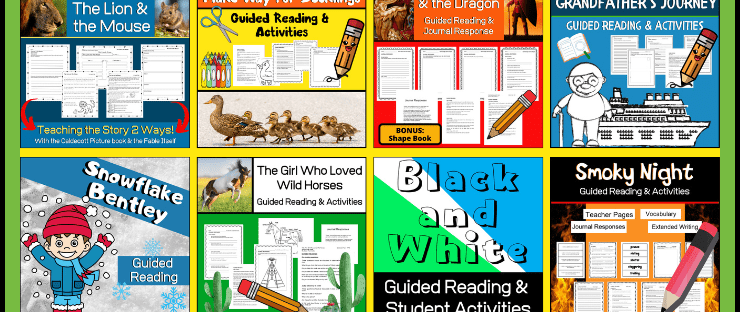
Here are just a few preview images from a few of the included units:

Not an All-Access member? When you purchase the Literature Bundle, you’ll save 20% off purchasing each individually! 

Need the books for the above units? 
If you do not already have these books, you can go to your local library to borrow them or you can purchase them and have them delivered to your door. The following links will take you to view and purchase on Amazon. My Teaching Library is an Amazon associate:


Join My Teaching Library on social media…

FB Group (PRIVATE GROUP)
FB Page
Pinterest
X (formally twitter)
YouTube

Literature Connections, Uncategorized

Holes Advanced Novel Study: Literary Elements, Analysis, and More

This is an in-depth novel study of Louis Sachar’s Holes in which students will delve into literary elements of the book, analyze various topics and themes, write arguments and opinions, conduct research and more! This unit is designed for advanced 6th-8th graders and High School students.

Sections of this 112 page study include:
– Summary
– Metaphors and Similes
– Irony
– Imagery
– Fairy Tale Elements
– Literary Elements
Lesson Plans
– About the Author
– Key Aspects
– Part 1 (Chapters 1-9)
– Part 2 (Chapters 10-20)
– Part 3 (Chapters 21-30)
– Part 4 (Chapters 31-40)
– Part 5 (Chapters 41-50)
Final Essays
– Essay Suggested Questions
– Grading Rubric
– Final Essay Answer Key
Final Exam
– Answer Key
Optional Extension Activities


Thank you for visiting and reading this post from My Teaching Library!

My Teaching Library is a family-owned business started by a mom (and now grandma) with over 30 years of experience in the field of education. Having worked as a public-school teacher prior to becoming a full-time homeshcooling mom, Lynda has experience from both perspectives and is dedicated to creating and sharing with YOU the very best resources to help you teach your children. In an effort to help you SAVE TIME and MONEY as a teacher and homeschooling parent.

To save you time, she has created and gathered thousands of resources now available to you for instant download all on one site, MyTeachingLibrary.com. It is also important to her that children are taught as the unique learners that they areLearn the My Teaching Library difference.

To save you money, she offers two ALL-ACCESS membership plans. Members do not pay listed prices, instead they only pay for membership!

Join Lynda and My Teaching Library on social media…
FB Group
FB Page
Pinterest
X (formally twitter)
YouTube

10th Grade, 11th Grade, 12th Grade, 9th Grade, High School, Literature Connections

Pride and Prejudice – Why Teach this Novel?

Brief story overview: Set in England in the early 19th century, Pride and Prejudice tells the story of Mr and Mrs Bennet’s five unmarried daughters after the arrival of the rich and eligible Mr Bingley, and his status-conscious friend, Mr Darcy, in their village. While Bingley takes an immediate liking to the eldest Bennet daughter, Jane, Darcy has difficulty adapting to local society and repeatedly clashes with the second-eldest Bennet daughter, Elizabeth. It is an 1813 romantic novel of manners written by Jane Austen and follows the character development of Elizabeth Bennet, the dynamic protagonist of the book who learns about the repercussions of hasty judgments and comes to appreciate the difference between superficial goodness and actual goodness. Its humor lies in its honest depiction of manners, education, marriage, and money during the Regency era in Great Britain.

“I am amusing myself with Miss Austen’s [sic] novels. She has great power and discrimination in delineating common-place people; and her writings are a capital picture of real life, with all the little wheels and machinery laid bare like a patent clock.”

—Henry Wadsworth Longfellow, Journal entry, May 23, 1839

So why have students read this 19th century novel?

I could give you several reasons that seem to be ‘literary learning’ in nature such as…

  • To study the author’s use of satire and irony as well as many other literary devices
  • The novel has a strong female protagonist and thus a study of her role would lead to rich discussion
  • The ability to make strong contrasts between characters and how Austen builds our knowledge of each
  • To find and study the many themes of the novel and how these themes relate to students’ lives today

…and while all of these would be true, that’s not what I’m going to do. Instead I’m simply going to highlight several ‘life lessons’ that can be learned while reading and examining the story and characters.

Lessons which can be learned while reading Pride and Prejudice

Pride and Prejudice

1. It’s okay not to be good at everything.

Elizabeth Bennet, the novel’s heroine, is interesting not because she’s good at everything, but precisely because she isn’t. She and her eventual husband, Mr. Darcy, have a conversation early in the novel about what defines an “accomplished” woman.  Darcy indicates that such a lady would be able to play music, sing, dance, draw, speak several languages, and read frequently.  Rather than pretend she possesses these qualities—or feel ashamed that she doesn’t—Elizabeth accepts who she is.

Elizabeth replaces exhausting exceptionalism with passion.  There are certain things that she is passionate about—reading, her family, travel—that make her unique and, in fact, endear her to Mr. Darcy.

As you teach this novel, point out this fact to students to remember that it’s okay not to be good at everything and life is a learning process. Have them take time to reflect on (and try to discover) the passions and qualities that make each of them unique.

2. Don’t make snap judgments.

This is the obvious lesson of the novel—don’t judge the proverbial book by its cover.  This lesson is as important as ever in today’s society.  Remind students not to let their first impressions dictate how they feel about people, ideas or even activities. Don’t shy away from something because you fear it—try to view it from a different perspective. Ask them to allow others to surprise them! To keep an open mind as they might find that people may contradict the image they first presented to them.

3.  The importance of planning.

In this easily-readable novel, Ms. Austen underscores the importance of planning.  Pride and Prejudice as perfectly-structured a novel as ever was written: from the initial tension in Elizabeth and Darcy’s meeting to the disastrous anticlimax of the first proposal, the upward trajectory of Elizabeth’s feelings for the man she’d judged poorly, Darcy’s climactic saving of the Bennet family’s reputation, and his subsequent successful proposal of marriage to Elizabeth, the novel moves quickly and deliberately in precisely-plotted chapters.  Austen wastes no time with frivolous details: everything ties together; each scene has a purpose.

Ask students to take a page from Austen’s book as they plan both in school and in life.  Careful preparation can lead to great success!

4. A little humor goes a long way.

Despite the beliefs of some, Pride and Prejudice is not just Victorian chick book.  It’s a romantic tale with a marriage plot, to be sure, but it’s also a comedy.  From the sycophantic Mr. Collins to the drily sarcastic Mr. Bennet, the novel is filled with jokes, little nods from Austen to the reader.  The book is really funny.

Pride and Prejudice Novel Study
Complete novel study for Jane Austen’s Pride and Prejudice (196 pages). Includes:
– Author’s Biography
– Novel Introduction
– Characters and Themes
– Quotes and Analysis
– Teaching Guides dividing the novel into 5 sections w/
* Chapter Summaries, Thought Questions and Vocabulary
* Student Handouts
* Student Worksheets, Assessments & Keys
– Final Assessments

Pride and Prejudice Vocabulary Study
Complete novel study for Jane Austen’s Pride and Prejudice (196 pages). Includes:
– Author’s Biography
– Novel Introduction
– Characters and Themes
– Quotes and Analysis
– Teaching Guides dividing the novel into 5 sections w/
* Chapter Summaries, Thought Questions and Vocabulary
* Student Handouts
* Student Worksheets, Assessments & Keys
– Final Assessments

Pride and Prejudice | Assessments
Looking for only a way to test student reading comprehension and understanding as they read Jane Austen’s Pride and Prejudice? The resource will give you 5 quizzes for students to take while reading the novel and then after they have completed the entire novel, an essay assessment as well as a 20 question, multiple choice test. Answer Keys included!

Need a copy of the book itself?

Pride and Prejudice (Jane Austen)

If you’d like a FREE PREVIEW of what you’ll get if you download the Pride and Prejudice Novel Study, simply click here to instantly download a preview.

________________________

>> Learn more about My Teaching Library! <<